
Denver PPC is a pay-per-click agency in Englewood, Colorado, running Google, Meta and Microsoft Ads. It sells the same service into two different markets: business owners who want more leads, and marketing agencies who want campaigns run under their own brand. Two markets, two very different buying decisions — and the old site had one front door, with a sign above it that only spoke to one of them.
We rebuilt it. The new site went live on 3 September 2026.
Denver PPC is a sister company — same owner, separate businesses. That is also why we can show you this much of a rebuild in this much detail.
There are no traffic or lead numbers in this case study. The site is days old, and any figure we published now would be noise dressed up as a result. What is here is the full before and after of the work, and the visibility number the new site starts from — so when we do publish a comparison, it is against a line you can already see.
The ask
Protect the rankings first. Denver PPC had years of accumulated search visibility, and a redesign is the fastest way to lose it — URLs that change without redirects, pages that quietly disappear, a domain that stops resolving to a single address. That was the main goal, and everything else was conditional on it: no part of the rebuild was worth doing if it cost the site what it had already earned.
Then, on top of that: rebuild it so it sells into both markets without either one feeling like it has landed in the wrong place, and fix the search and answer-engine problems the old site had been carrying for years.
The preservation work is the least visible part of the project and the part with the most at stake, so it is worth naming what it involved: every old address tested against the new site one by one, redirects written for the ones that moved, the single article in the archive that was actually earning visibility rebuilt and kept at its original URL, and the http and www versions of the domain checked to make sure they resolve to one canonical address. Whether it worked is a question the first full month of data answers — see Where it stands below for the line it will be measured against.
The homepage was only addressed to one of the two markets
The most-read line any business publishes is its homepage title tag — the blue link people actually click in a search result. Denver PPC’s read White Label PPC Services for Agencies | U.S. Based PPC Management Experts. A business owner looking for someone to run their Google Ads had no reason to click it.
It was also 73 characters long, so Google cut it off before the end. The description underneath had the same problem at 161 characters. The replacement names both markets and fits inside what Google displays: PPC Management Services & White Label PPC | Denver PPC, 54 characters, with a 150-character description beneath it.
What we changed
- Mapped the old addresses to the new ones. Every rebuild changes URLs, and every changed URL is a link someone else still points at. We tested the old addresses one by one against the new site: more than twenty redirect to their new homes, and the http and www versions of the domain resolve cleanly to a single canonical address.
- Two doors, both labelled. The homepage splits the moment you land on it — one path for businesses, one for agencies. Nobody has to work out which half of the site is meant for them, and each phrase gets a page to own instead of one page competing with itself.
- Wrote pages that answer questions. Seven of them, each built around something people actually type: what pay-per-click advertising is, how it works, what it costs, how to budget for it, what a good return on ad spend looks like, how to improve performance, and Google Ads versus Facebook Ads. An eighth was added afterwards when we rebuilt the one article in the old archive that was still earning rankings. Each opens with a direct answer in its own box — the shape a search engine or an AI assistant can lift whole.
- Promoted the case studies out of the blog. Three case studies had been filed as blog posts, where nobody found them. They became eight proper case study pages with a hub of their own.
- Made the business legible to machines. The old homepage published three kinds of structured data, enough to say “this is a page on a website”. The new one adds the three that describe a business and its answers — Organization, ProfessionalService and FAQPage — plus the company’s name, address and phone number written into the markup, a plain-language definition of what the company does, and a real FAQ section.
The homepage, before and after
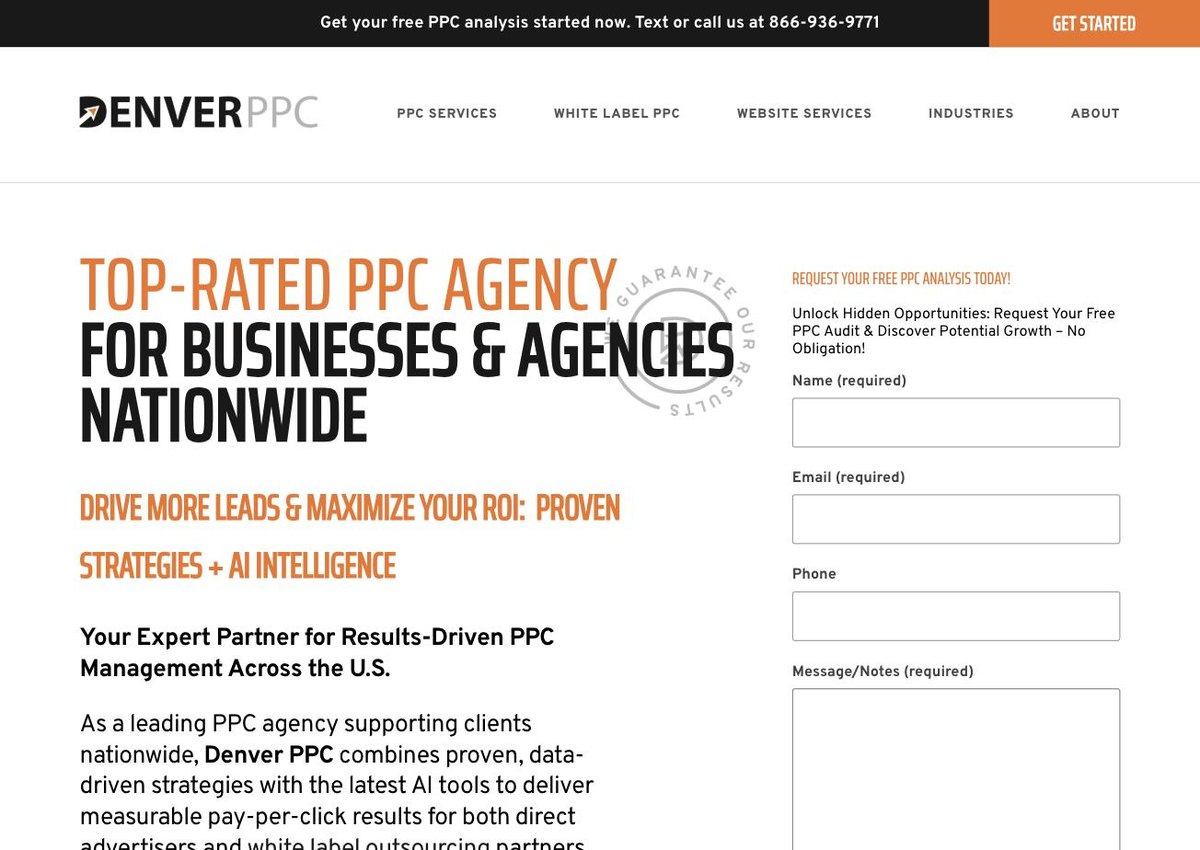
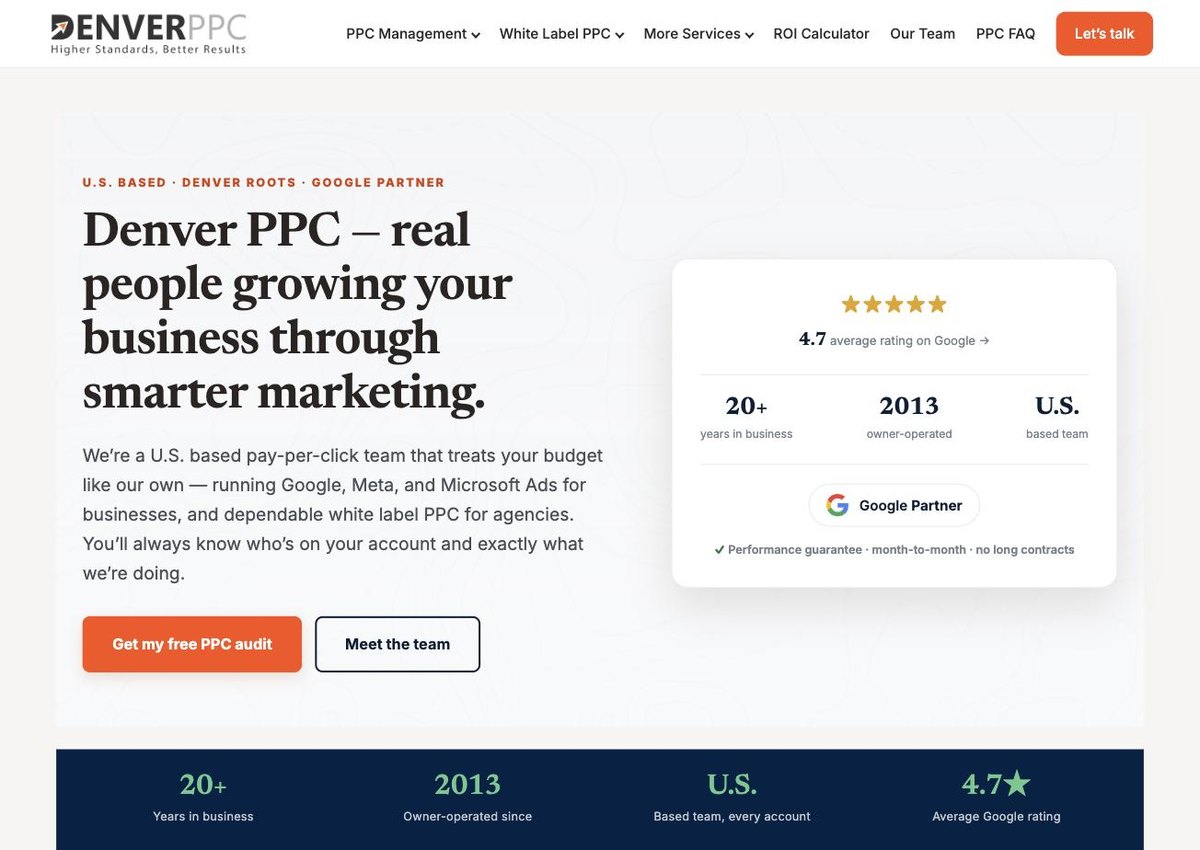
The old hero gave half its space to a lead form and set its headline in condensed orange capitals claiming a ranking. The new one gives that space to the claim itself, with the proof sitting beside it: the Google rating, years in business, owner-operated since 2013, U.S. based team, Google Partner — and two clear things to do next.
An archive nobody had added to in a year
Behind the old site sat 157 published posts going back to 2008, under a page called Marketing Resources. Not an active blog — an archive. Sixty-one of them were written in 2008 and 2009. Two had been published since the start of 2024, and none at all in 2026.
We checked every one of them against Semrush. Outside a single article, the entire archive ranked for nothing and brought in no traffic. It was volume standing in for authority. The one article that was earning visibility was rebuilt and kept at its original address, so the rankings it held were not thrown away.
Where it stands
Live since 3 September 2026. In the month before launch, the domain appeared in Google for 623 organic keywords, according to Semrush’s US database. That is the line the rebuild will be measured against — and everything that produced it happened before the new site existed, so none of it is a result of this work. It is the starting position, not the score.
It is also a visibility measure, not a traffic measure: it counts the searches a site appears for, not the people who arrive. We will publish the first real comparison once there is a full month of data behind the new site, and we will publish it whether the line goes up or not.
Need a website refresh too?
We do this work for businesses that have outgrown a site built years ago — the rebuild, the search and answer-engine side, and the redirect map that keeps what you have already earned. It is built around your brand, not ours.
The easiest way to see what that would look like for you is to ask for a free homepage mockup — we design your new homepage first, in your brand, before you spend anything. Or see our website design and redesign services, or ask us to look at your site and we will tell you what we would change and why, whether or not you hire us.
